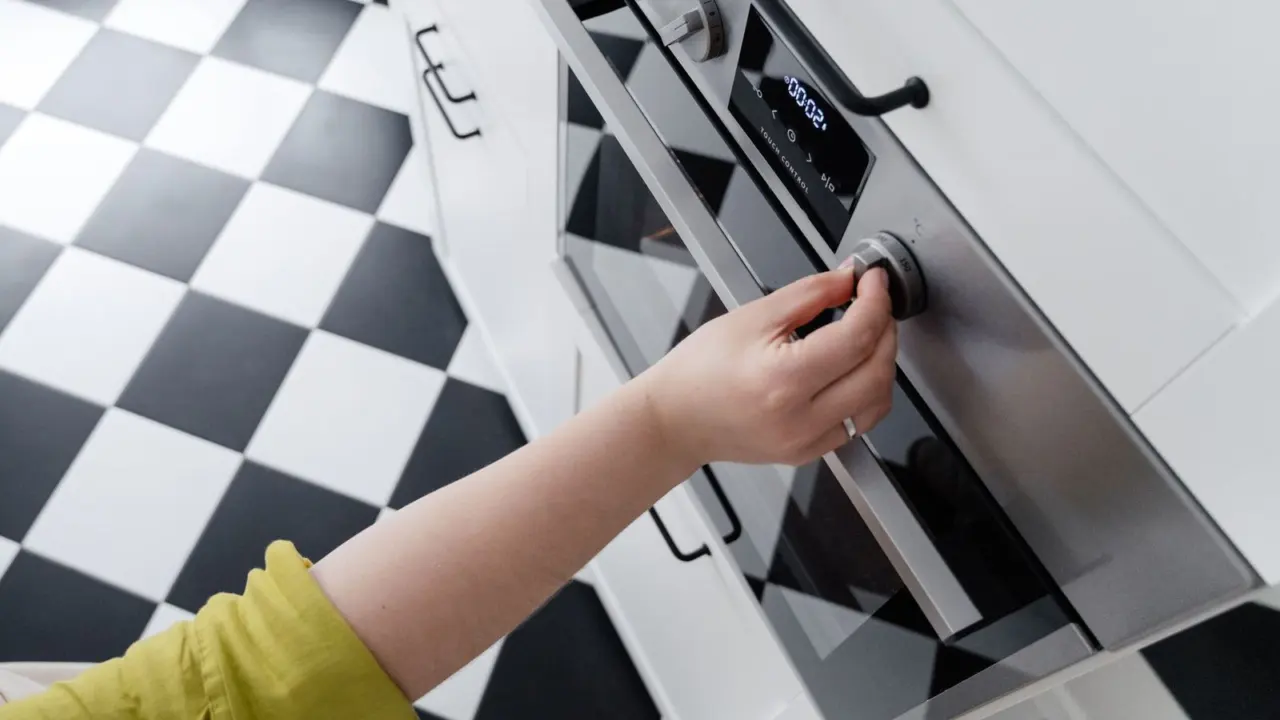
Staring at a recipe in gas mark while your dial shows Celsius? Oven temperature conversion is quick with a chart: 180°C is 356°F, gas mark 4, or 160°C on a fan oven.
| Item | Value |
|---|---|
| 180°C in Fahrenheit | 356°F |
| 180°C in gas mark | Gas mark 4 |
| 180°C conventional, fan oven setting | 160°C |
| 200°C in Fahrenheit and gas mark | 392°F, gas mark 6 |
| 350°F in Celsius (Beko chart) | 177°C, gas mark 4 |
These figures come from the Smeg UK conversion chart and the Beko UK conversion guide. Manufacturers’ charts differ slightly and can change, so check the source before you rely on them.
The quick conversion chart
Most ovens in the UK measure temperature in degrees Celsius, but some use gas mark or Fahrenheit, as Beko’s guide explains. The chart below uses Smeg’s published values for a conventional oven, with the fan equivalent alongside.
| Celsius (conventional) | Fahrenheit | Fan oven | Gas mark |
|---|---|---|---|
| 140°C | 284°F | 120°C | 1 |
| 150°C | 302°F | 130°C | 2 |
| 160°C | 320°F | 140°C | 3 |
| 170°C | 338°F | 150°C | 3.5 |
| 180°C | 356°F | 160°C | 4 |
| 190°C | 374°F | 170°C | 5 |
| 200°C | 392°F | 180°C | 6 |
| 220°C | 428°F | 200°C | 7 |
Values are taken from the Smeg UK chart; other makers’ charts can differ slightly, so check the source before you rely on them.
Delicate bakes such as sponges and custard-style cakes usually sit in the middle of this chart. Find your recipe’s number in whichever column it uses, then read across.
Keep the chart open in a tab or write the handful of settings you use most on a card inside a cupboard door. Most home baking lands on only a few of these rows, so you will soon know them by heart.
Why two charts can disagree
Beko lists 350°F as 177°C, while a round recipe number would be 180°C. Beko itself says the conversions are approximate, and adds that some products have different gas mark temperature ratings.
In practice, a few degrees either way will not ruin a cake. What matters more is whether you read the right column, since a conventional figure and a fan figure for the same bake are far apart.
Converting Celsius and Fahrenheit by formula
If your temperature is not on a chart, use the formula. Smeg gives it in words: subtract 32 from the Fahrenheit temperature, multiply by 5, then divide by 9 to reach Celsius.
Going the other way, multiply degrees Celsius by 9, divide by 5, then add 32, per the same Smeg page.
- Write down the temperature in the recipe.
- Apply the steps in the order given, without skipping the subtraction or addition.
- Round to the nearest figure your dial can actually show.
Rounding is fine for baking. Most dials move in steps, so a result that lands between two marks should go to whichever is closest to the recipe’s intent.
Fan oven or conventional: which column do you use?
In the Smeg chart the fan figure sits 20°C lower than the conventional one: 180°C conventional pairs with 160°C fan.
Check which type of oven the recipe was written for. If it does not say, check with the recipe source before adjusting the temperature. Look at the bake early, since fan heat can brown the top sooner.
- Recipe says conventional, your oven is fan: use the fan column.
- Recipe says fan, your oven is conventional: use the conventional column.
- Recipe says gas mark: find the gas mark first, then read across to your oven type.
Modern ovens often have several modes, such as fan, top and bottom heat, or a grill. If you are unsure which your dial symbol means, check the manual before you commit a precious batch.
Getting the heat right in your own oven
Dial numbers are a guide, and ovens vary. A small oven thermometer hung on the middle shelf tells you what is really happening, and you can adjust the dial to match.
Accuracy in the other steps helps too. Weigh with care, as covered in our guide on how to measure flour, and prepare your tin properly, as shown in how to line a cake pan. For more fundamentals, see our baking basics pages.
Preheat fully before the bake goes in, and keep the door closed for the early part of baking. Opening it lets heat escape and the temperature drops.
Small habits that protect your bake
- Bake on the middle shelf unless the recipe says otherwise, so heat reaches the tin evenly.
- Turn the tin partway through if one side browns faster than the other.
- Cover the top loosely with foil if it colours before the centre is set.
- Judge doneness by look and feel, not only by the timer.
Soft Japanese-style bakes, such as sponge cakes and cheesecakes, reward gentle, even heat. A thermometer and an early check usually matter more than chasing a perfect number from a chart.
Applying oven temperature conversion to Japanese-style desserts
Many Japanese dessert recipes are written in Celsius for conventional or fan ovens, and some use a steam-bake method in a water bath. Always read the recipe’s note on oven type before you convert anything.
Soft bakes such as castella, cotton cheesecake and roll cakes are sensitive to heat. If the top browns too fast, the centre may not set, and the cake can crack or sink as it cools.
- Convert once, at the start, and write the new setting on the recipe so you do not convert twice.
- Use an oven thermometer on the shelf where the tin will sit.
- Note the real result next to the recipe, such as “browned early, lower next time”.
- Change one thing at a time, either the temperature or the time, so you learn which helped.
Over a few bakes, your notes become a personal conversion chart for your own oven. That record is worth more than any generic table, because it reflects how your oven actually behaves.
Frequently asked questions
What is 180°C in Fahrenheit and gas mark?
Show answer
Smeg’s chart gives 356°F and gas mark 4 for 180°C in a conventional oven. Many recipes round this to 350°F.
What is 350°F in Celsius?
Show answer
Beko’s chart lists 350°F as 177°C and gas mark 4. Most cooks round to 180°C.
How do I convert a conventional recipe for a fan oven?
Show answer
Use the fan column. In Smeg’s chart it is 20°C lower, so 180°C becomes 160°C.
Are oven conversion charts exact?
Show answer
No. Beko states its conversions are approximate, and different makers rate gas marks differently. Use an oven thermometer to check.