Worried your cake will weld itself to the pan? Here is how to line a cake pan: fold parchment into a triangle, trim it to the base, unfold a neat round, and lay it in.
This guide is part of our baking basics series, written for home bakers who want a clean release every time.
| Item | Value |
|---|---|
| First fold | Bring the two long sides together and crease the centre into a large rectangle |
| Second fold | Fold the rectangle in half to make a smaller rectangle |
| Shaping the tip | Bring the folded edges together so the tip forms a triangle with uneven sides |
| Trimming guide | Use the edge of the pan to trim the base of the parchment |
| Final step | Unfold the parchment to reveal the round liner |
These steps come from Reynolds Brands’ parchment liner guide. Instructions can change, so check the source before you rely on them.
Why a parchment liner is worth the effort
A greased pan alone often leaves the bottom layer clinging in patches. A parchment round gives the cake base a barrier, so the layer slides out whole instead of tearing.
The same Reynolds guide lists two benefits: easy release, because the cake does not cling to the bottom of the pan, and even baking regardless of the type of pan. Neither needs special skill, only a sheet of paper and scissors.
This matters for delicate Japanese-style sponges, such as chiffon or castella-type cakes, where a torn base shows. It matters just as much for layer cakes that need flat, intact rounds for stacking.
What you need before you start
Gather everything first, because the folding goes quickly once you begin.
- A roll or sheet of parchment paper, wider than your pan
- Sharp kitchen scissors
- Your cake pan, clean and dry
- Soft butter or neutral oil, plus a pastry brush or paper towel
Tear off a piece that is clearly larger than the pan. A generous sheet is easier to fold than one that barely fits.
Check that the pan is the one the recipe names. A pan that is too big or too small changes the batter depth, and that changes both the bake and the shape of your liner.
How to line a round cake pan, step by step
This is the fold-and-trim method from the Reynolds guide. It works for any round pan, whatever its size.
- Tear a sheet of parchment larger than the pan.
- Bring the two long sides together and crease the centre to make a large rectangle.
- Fold the rectangle in half to make a smaller rectangle.
- Bring the folded edges together so the tip forms the top of a triangle with uneven sides.
- Flip the pan over and place the triangle against the bottom, with the point at the centre of the pan.
- Trim the parchment base using the edge of the pan as a guide.
- Unfold the parchment to reveal the round liner.
- Flip the pan back over and lay the parchment liner inside.
Pressing the folded triangle firmly before you cut keeps the edge straight. A crisp crease means a crisp circle.
If your first liner comes out a little small, do not stretch it. Use it as a template, lay it on a fresh sheet, and trace a slightly larger one.
Once you have one good circle, keep it. Tracing around it makes matching liners for a whole stack of layers quick, and every layer comes out the same size.
Work on a clean, dry counter so the paper does not pick up flour or crumbs. Those would end up pressed against the bottom of your cake.
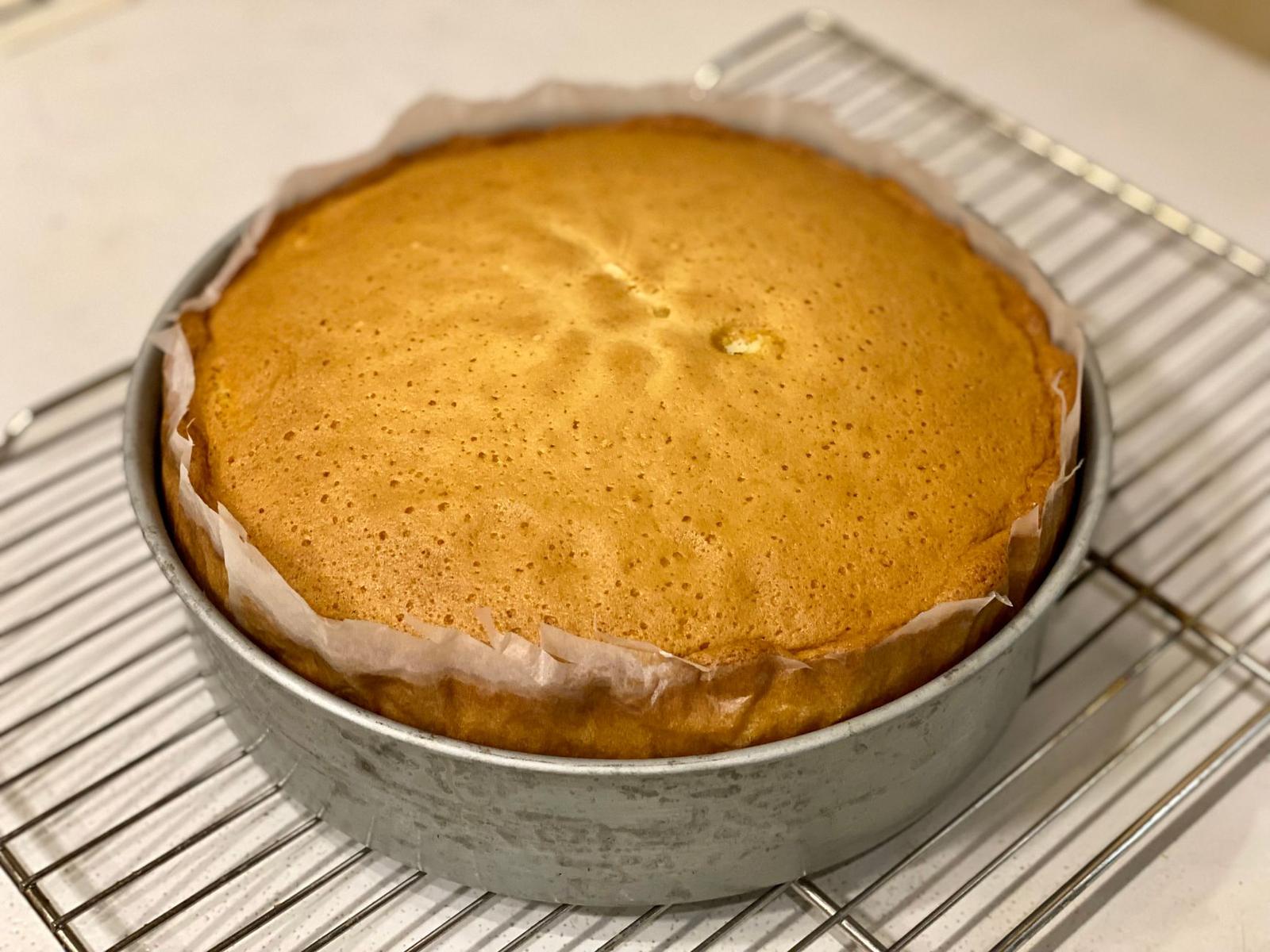
Greasing, sides and other small choices
Parchment covers only the base. If the recipe calls for it, brush the sides of the pan lightly with butter or oil so the edges release too.
Many bakers also dab a little fat under the liner so it stays put while you pour. A liner that slides around can wrinkle and leave ridges on the cake bottom.
If your recipe says to leave the sides ungreased, as some sponge cakes do so the batter can climb, follow the recipe. Run a thin knife around the edge after baking instead.
- Cut the circle a touch inside the pan edge rather than outside it, so it lies flat.
- Smooth out any creases from folding before adding batter.
- Peel the parchment off while the cake is still slightly warm, once it has been turned out.
Square, rectangular and loaf pans
Straight-sided pans are even easier. Cut a strip as wide as the pan base and long enough to overhang two opposite sides.
The overhang works as a pair of handles, so you can lift a brownie slab or a loaf out in one go. Snip into the corners if you also want to line the walls.
Once the pan is ready, the batter matters next. Our guide on how to fold batter shows how to keep a light mixture airy as you transfer it into the lined pan.
When to skip or change the liner
Not every cake wants a paper base.
Always read the method first. If the recipe names a lining style, follow it.
- Chiffon-style sponges often need an ungreased tube pan, so follow the recipe closely.
- Rich butter cakes and layer cakes almost always benefit from a base liner.
- Sticky bakes, such as those with fruit or caramel, release far more easily with a liner.
When in doubt, line the base and treat the walls as the recipe directs. That small habit solves most sticking problems.
Common mistakes to avoid
Most failures come from a liner that does not fit. Check these points before you pour.
- Circle too large: it buckles up the sides and leaves wavy edges. Trim again.
- Circle too small: batter seeps underneath and glues the cake down. Cut a fresh one.
- Wrong paper: wax paper is not a substitute for parchment in the oven.
- Paper near the heat: keep loose edges out of contact with heating elements.
Also check the temperature printed on your parchment package. Recipes from other countries often use different units, so our page on oven temperature conversion is a useful companion before you preheat.
Frequently asked questions
Do I still need to grease the pan if I use parchment?
Show answer
Usually yes for the sides, unless your recipe says otherwise. Parchment only covers the base, so the walls still need fat or the recipe’s preferred method.
Can I reuse a parchment liner?
Show answer
It is best to cut a fresh one for each bake. A used liner is often creased, greasy or browned, and it may not lie flat.
Which side of the parchment faces up?
Show answer
Tutorials differ, and for standard parchment it rarely changes the result. Use whichever side lies flatter, and follow your package’s note if it gives one.
Can I use a pre-cut parchment round?
Show answer
Yes, if the size matches your pan. Pre-cut rounds save time, but you would need one size per pan, so many bakers cut their own.