Worried your sponge will collapse the moment you mix it? Here is how to fold batter: cut down, sweep under, turn over, and stop the second large streaks vanish.
This guide is part of our baking basics series on techniques behind Japanese desserts.
| Item | Value |
|---|---|
| First addition of whipped whites | About a quarter, stirred in to loosen the batter |
| Alternative first addition | A third or less |
| Folding stages for whipped whites | Three |
| Best bowl | Large, wide, with rounded sides |
| Best tool | Large silicone spatula |
| When to stop | When large streaks are gone |
Figures come from KitchenAid UK’s folding guide and Tasting Table. Recipes differ and pages get updated, so check the sources before you rely on them.
What folding actually does
Folding combines a light, airy mixture with a heavier one while keeping as much air as possible. Whipped egg whites or cream carry the air that lifts a chiffon cake, a castella or a soufflé-style cheesecake. Every stroke that is too forceful pushes some of it out.
That is why a recipe says “fold” rather than “stir”. Stirring is round and round and works the batter hard. Folding is a slow lift-and-turn that moves ingredients through each other with the least effort possible.
KitchenAid UK says plainly that over-mixing is the risk: “Overmix, and it will deflate the structure.” Most folding advice comes down to that one idea.
Set up before you start
Good folding begins before the spatula touches the bowl. Three choices matter most.
- The bowl: use a large, wide bowl with rounded sides. A cramped bowl forces extra strokes, and corners trap pockets of unmixed batter.
- The tool: a large silicone spatula is the usual choice. It is flexible enough to scrape the bowl and wide enough to move a lot of batter per stroke.
- The whites: whip them to the stage your recipe names and use them promptly. Over-whipped, dry whites tend to break apart as you fold.
Have your pan ready too, because a folded batter should not wait around. If you are unsure how to prepare it, see our guide on how to line a cake pan before you begin.
How to fold batter, step by step
The method below is for whipped egg whites into a base batter. It follows the staged approach both sources describe.
- Loosen the base. Add about a quarter of the whites to the heavier batter and stir it in. KitchenAid UK describes this as adding “about a quarter of the lighter mixture”. Tasting Table says a third or less. Do not worry about losing air here: this portion is a sacrifice that makes the batter easier to fold into.
- Add the next portion on top. Spoon more whites onto the batter, without stirring them in first.
- Cut down. Slice the spatula straight down through the centre to the bottom of the bowl.
- Sweep and lift. Drag the spatula along the bottom and up the side, so it brings heavy batter up and over the top of the whites.
- Turn the bowl. Rotate it a little and repeat. The turning means you work all around the bowl rather than in one spot.
- Add the last portion and repeat the cut, sweep and turn until the batter looks even. The next section explains how to judge that moment.
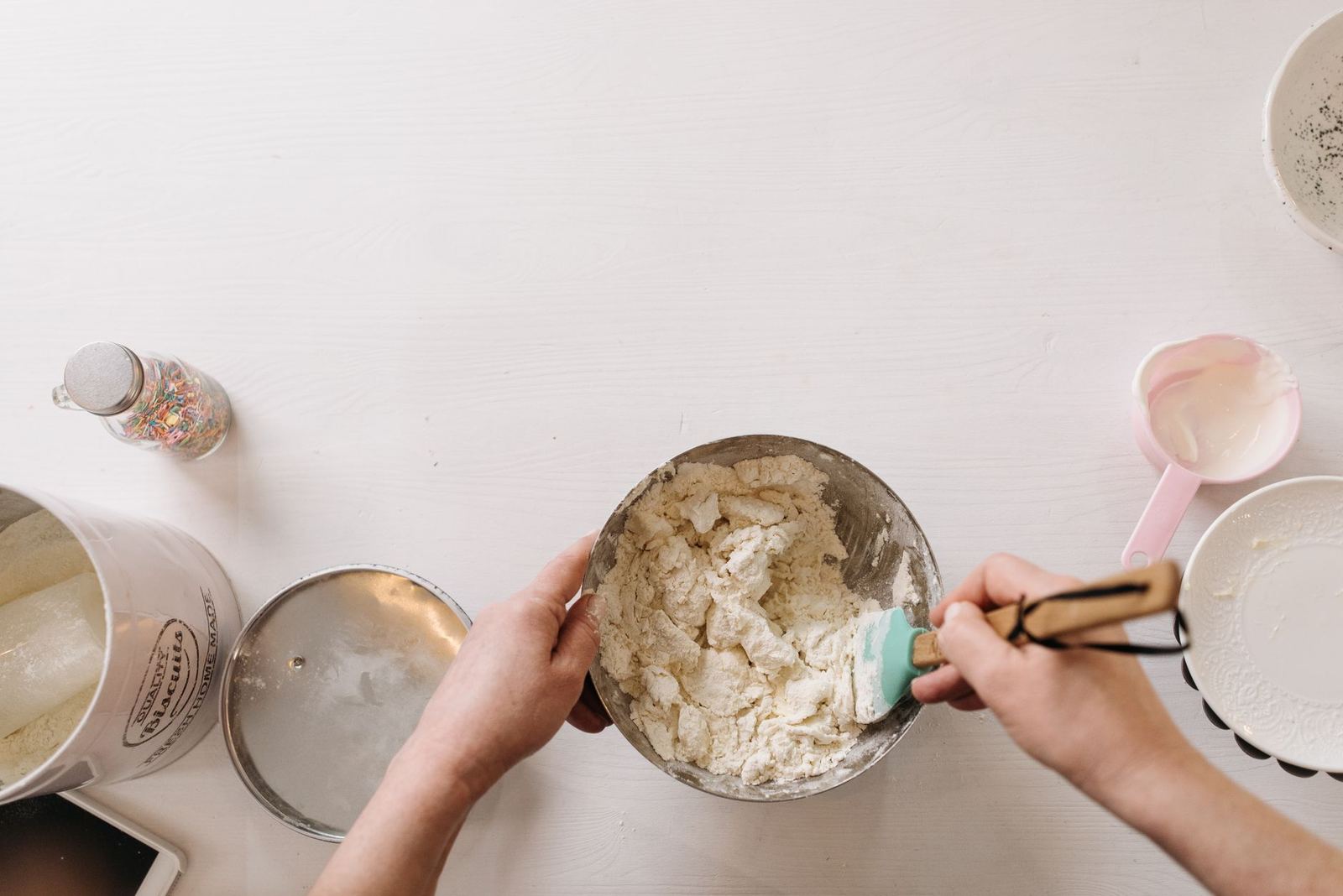
Work steadily rather than fast. Short, confident strokes beat many nervous ones.
Knowing when to stop
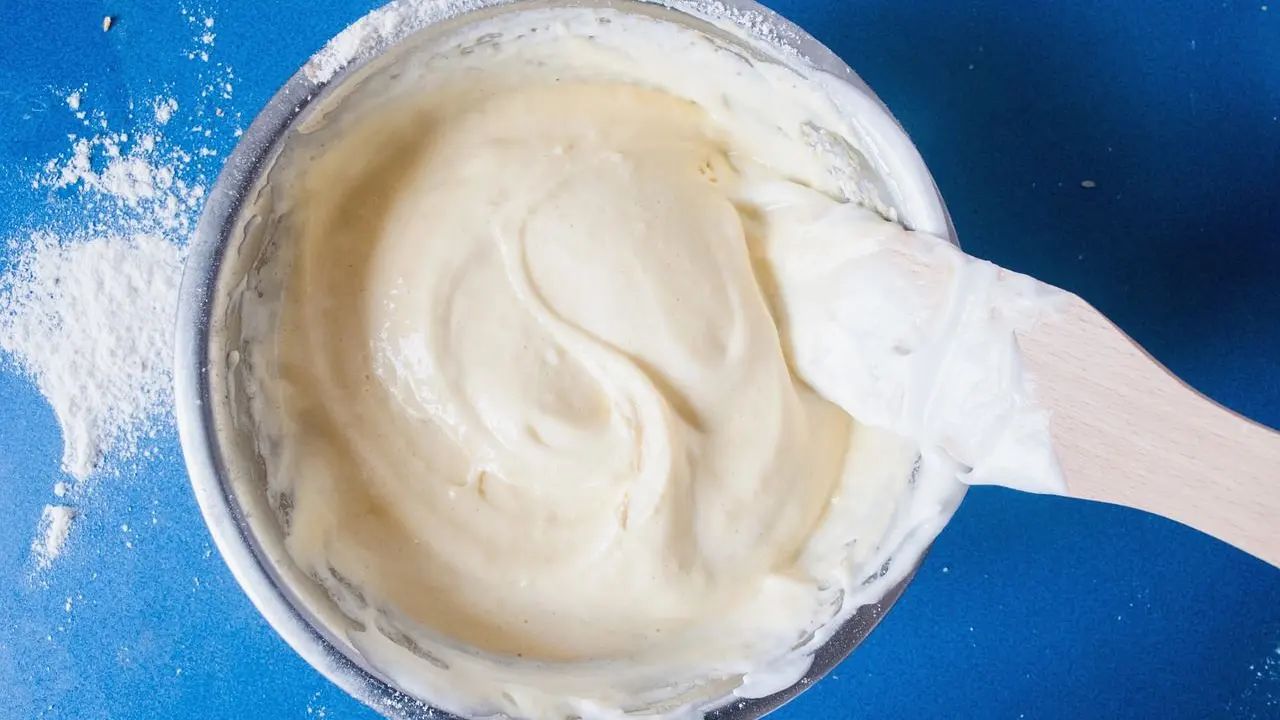
Folding is a judgement call, and the signal is visual. KitchenAid UK says to stop “when you can’t see large streaks anymore”. A few tiny wisps are better than a flat, over-worked batter.
Look for an even colour and a smooth, billowy texture. White patches mean you need a few more strokes. If the batter looks thin and runny, you have probably gone too far.
If the batter is pale and you see no clear streaks, set the spatula down. Pour it into the pan straight away and move on.
Folding in flour and dry ingredients
KitchenAid UK advises you to “sift it in gradually instead of dumping it all on top at once”. Sifting stops lumps and lets you mix in small amounts with fewer strokes.
Use the same cut-sweep-turn motion. Add the dry ingredients in a few lots and fold each one until the flour disappears before adding the next.
Flour does not just add dryness. Once it is wet, working it for too long builds a tougher crumb, so the same “stop early” rule applies here.
Folding other light mixtures
The same motion works for whipped cream, meringue and mousse bases, not only egg whites. In each case you are blending something airy into something dense, and the aim is the same: keep the bubbles.
Some practical habits help whatever you are folding:
- Keep the heavier mixture at a workable consistency so it does not fight the light one.
- Fold the airy part in portions rather than all at once, as the staged method shows.
- Scrape the bottom of the bowl, where the dense mixture likes to settle.
- Keep your wrist loose. The spatula should glide through, not push.
When you read a recipe for a Japanese sponge or a cheesecake, look at how it describes the fold. Phrases such as “gently” or “until just combined” usually point to the same stop-early rule described above.
Practising the motion
Folding is a feel you build by repeating it. Try the stroke in a bowl with a thick yoghurt and a spoonful of whipped cream, and watch how the colours blend as you cut and turn.
You will notice that the spatula glides more easily after the first few folds, which is the same effect KitchenAid UK describes: “A few folds later, your spatula starts gliding through much more smoothly.” That smoothness is your cue that the mixtures are joining.
Take your time on the first attempts. A slightly under-folded batter is easy to fix with a couple more strokes. A flat, over-folded one cannot be rescued.
Common mistakes and quick fixes
- Batter lost volume: KitchenAid UK says to stop folding “the second the large streaks disappear” next time, because over-mixing is the usual cause.
- Streaks of white left in the cake: you stopped too soon, or the whites were not mixed into the bottom of the bowl. Reach all the way down on each stroke.
- Lumpy whites: this can happen when whites sit too long or are over-whipped. Fold in the next batch of whites straight after whipping.
- Batter sticking in a corner: switch to a wider bowl so the spatula can reach everywhere.
Baking method matters after folding too. Delicate batters such as cheesecakes often bake gently, and our guide on how to bake in a water bath explains how.
Frequently asked questions
Can I use a whisk to fold?
Show answer
A whisk can work for very loose mixtures, but KitchenAid UK recommends a large silicone spatula, while Tasting Table specifies a rubber spatula. It scrapes the bowl and lifts batter from the bottom in a way a whisk does not.
Why do I fold in the whites in stages?
Show answer
Tasting Table says to fold in three stages, starting with a third of the whites or less. The first portion loosens the heavy batter so the rest blends with fewer strokes.
How do I know I have folded enough?
Show answer
Stop when you can no longer see large streaks, as KitchenAid UK advises. A tiny wisp is fine, but overmixing deflates the structure.
Does the bowl really matter?
Show answer
Yes. KitchenAid UK recommends a large, wide glass or stainless bowl with rounded sides, so the spatula can move freely and nothing hides in the corners.